
Job Aid

How to conduct a facility audit in industrial workplaces

A step-by-step guide for planning, conducting, documenting, and following up on a facility audit in industrial workplaces. Use this job aid to identify hazards and document findings accurately and consistently. NOTE: Facility audits are comprehensive in nature and are different from work area inspections that should be conducted daily.

AudienceOperations team leaders, supervisors, and managers
Time to walkVaries by facility sq ft
FrequencyQuarterly minimum
Supervisor in a hard hat and safety vest walking a warehouse aisle during a facility audit

An effective audit starts with preparation. Know each of these before the walk.

Clipboard, flashlight, tape measure, and hard hat laid out before a facility walk
  • !Skipping the review of previous findings.
  • !Using a checklist from a template that doesn't match your facility's current processes.
  • !Not coordinating with maintenance, so equipment you need to inspect is running or locked out during your walk.

Before starting the audit, decide how you will move through the facility so that every area is covered.

Auditor inspecting overhead conduit and ceiling storage with a flashlight
  • !Moving quickly through familiar areas.
  • !Only auditing during day shift.
  • !Skipping storage rooms, mechanical spaces, or other areas that are not part of daily operations.
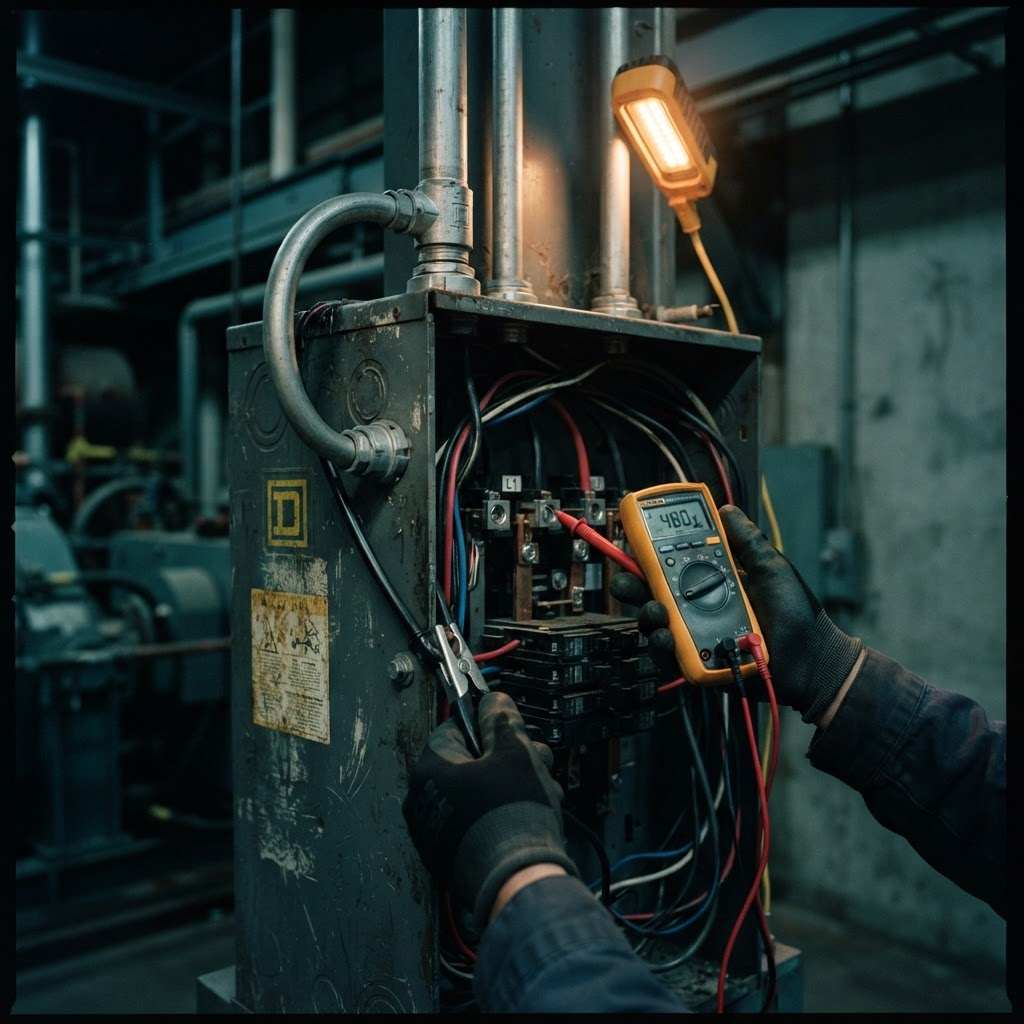
Electrical panel and multimeter being tested during a hazard inspection

These categories cover most of what you'll find in a general industrial facility. Tap any category for examples of what to look for.

  • ·Flammable liquids stored near ignition sources
  • ·Blocked or obstructed fire exits
  • ·Combustible dust accumulation on beams and ledges
  • ·Expired or missing fire extinguishers
  • ·Damaged or frayed power cords
  • ·Overloaded circuits, daisy-chained power strips
  • ·Missing panel covers or exposed conductors
  • ·Extension cords used as permanent wiring
  • ·Blocked electrical panels (need 36" clearance)
  • ·Missing or bypassed machine guards
  • ·No lockout/tagout on maintenance work
  • ·Pinch points without guarding
  • ·Unsecured compressed gas cylinders
  • ·Chemicals stored without proper labels
  • ·Missing or outdated SDS
  • ·Incompatible chemicals stored together (acid + base)
  • ·No secondary containment for liquids
  • ·No eyewash within 10 seconds of exposure risk
  • ·Bloodborne pathogen exposure without PPE
  • ·Improper sharps disposal
  • ·Mold in HVAC or damp areas
  • ·Standing water (Legionella risk)
  • ·Repetitive lifting above shoulder or below knee
  • ·Workstations forcing awkward neck or wrist posture
  • ·Loads over 50 lb without lift assist
  • ·No anti-fatigue mats at prolonged standing stations
  • ·Noise >85 dBA without hearing protection
  • ·Heat index >90°F without rest/water protocol
  • ·UV or laser exposure without shielding
  • ·Vibration exposure from powered tools
  • ·Aisles cluttered or blocked
  • ·Spills not cleaned
  • ·Slippery floors without warning cones
  • ·Trash overflowing near exits
  • ·Unsecured materials stacked above shoulder height
  • ·Workers in required areas without correct PPE
  • ·PPE stored improperly (contaminated respirators)
  • ·No PPE hazard assessment posted
  • ·Expired or damaged PPE still in circulation
  • !Only spotting hazards that match categories you're already comfortable with.
  • !Dismissing "the way we've always done it" as automatically safe.
  • !Missing near-misses that haven't caused an injury yet.

For every hazard, use this risk cube to rate the likelihood that the hazard will cause harm from 1–5 and the severity of that harm 1–5 which will generate a risk score from 1 to 25. Green (1–4) is low risk, yellow (5–9) is medium, red (10–25) is high. Tap any cell to see the definitions and the action required for each risk score.

Severity
Rare
(1)
Unlikely
(2)
Possible
(3)
Likely
(4)
Almost certain
(5)
Catastrophic
(5)
Major
(4)
Moderate
(3)
Minor
(2)
Negligible
(1)
Likelihood

Tap any cell above to see what that risk score means and how quickly it needs action.

  • !Scoring everything "medium" to avoid controversy or hard conversations with area owners.
  • !Confusing exposure frequency (how often the task happens) with likelihood of harm (how likely that exposure leads to injury).
  • !Downgrading a hazard so it doesn't trigger a mandatory reporting or notification requirement.

Use the hierarchy of controls listed below to determine the appropriate controls for the hazards you identified, considering their risk score. Always start at the top and work down. PPE should always be the last line of defense.

1
2
3
4
5
  • !Selecting PPE as the first control instead of considering higher-tier options.
  • !Selecting training as the control for a hazard that requires an engineering fix.
  • !Not documenting the reason a higher-tier control was not selected.

Record each hazard on its own row using a consistent format. Structured entries make it easier to compare findings and identify trends across audits.

Hands photographing a hazard on a warehouse floor with a phone and notepad nearby
  • !Vague descriptions, such as "area is unsafe," instead of specific findings like "cracked handrail on north stairwell, second landing."
  • !Photos with no location context, or blurry phone shots taken while walking.
  • !Presenting high-risk findings alongside lower-priority items without distinction.
  • !Sending the report to a single recipient.

Following up on corrective actions confirms that identified hazards have been addressed. Without follow-through, the same hazards will continue to appear in future audits.

Maintenance worker installing a new machine safety guard
  • !Assigning findings to a department such as "Facilities" or "Maintenance" instead of a specific person.
  • !Closing out a corrective action based on an email confirmation alone.
  • !Not reporting closure rates to leadership.
  • !Applying escalation inconsistently based on the individual assigned.